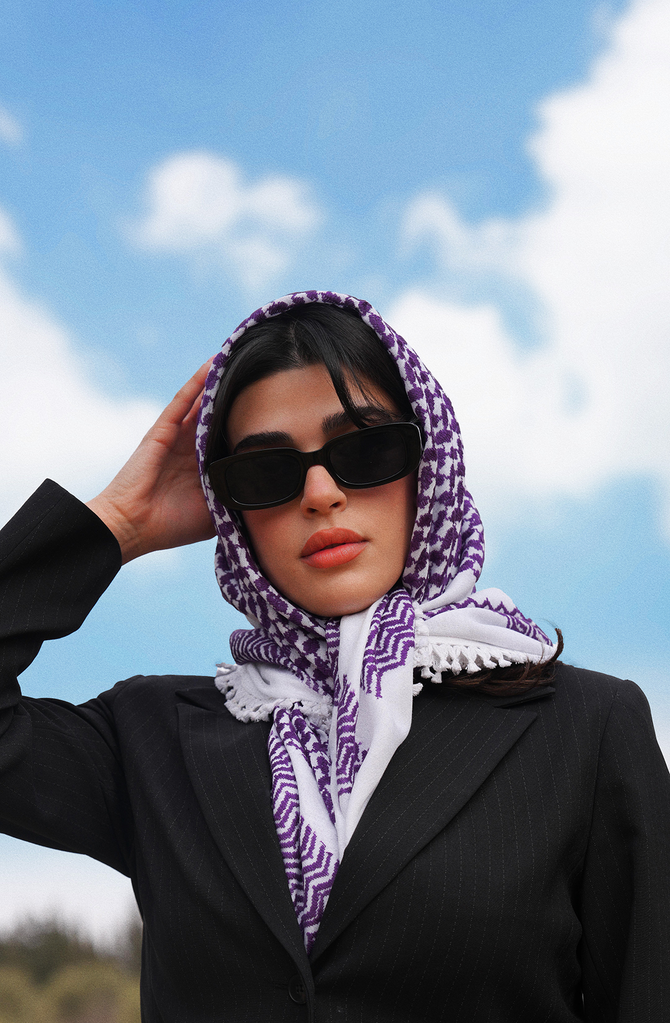


The Palestinian keffiyeh symbolizes identity, resistance, and belonging. What began as practical headwear for farmers became, over the last century, the most recognized emblem of the Palestinian people. Worn today around the world, it signals solidarity, and it carries a specific history that explains why.
At KUVRD, we approach the keffiyeh with care. Understanding its background matters. Without that context, it is easy to miss why this garment holds such lasting power.
What is the Palestinian keffiyeh?
The Palestinian keffiyeh, also called a kufiya, hatta, or shemagh, is a square woven scarf traditionally worn as a head covering. Most people recognize it by its black-and-white pattern, though variations exist.
Its history goes back thousands of years. Similar scarves were worn in ancient Mesopotamia, long before modern borders existed. The word itself is commonly traced to Kufa, a city in Iraq, with "keffiyeh" meaning "from the city of Kufa." Back then, the keffiyeh was practical. It protected people from heat, dust, and wind. Over time, that practical garment became something far more meaningful.

Where did the keffiyeh come from?
In Palestine, the keffiyeh was first worn mainly by rural workers, known as fellahin. Farmers relied on it while working outdoors in difficult conditions. Meanwhile, many urban Palestinians wore the tarboosh, a red felt hat that signaled social status.
That divide did not last forever. As political and social realities changed, so did the meaning of clothing. Slowly, the keffiyeh moved beyond class and became shared by the wider community. What once marked difference began to represent unity.
How did it become a symbol of resistance?
The keffiyeh's symbolism became especially strong during the Arab Revolt of 1936. At that time, Palestinians used it to cover their faces and protect their identity. When British authorities attempted to restrict it, people responded by wearing it openly and collectively.
Later, in the 1960s, the keffiyeh became closely tied to the Palestinian resistance movement. Yasser Arafat wore it in nearly every public appearance, and during years when the Palestinian flag was banned, the keffiyeh quietly took its place. It became a visible way to express identity without words.

Because of this history, the keffiyeh came to stand for resistance, unity, and belonging. Its role among other symbols of Palestinian identity — the olive tree, the key, the watermelon — is covered in our symbols guide.
What do the patterns mean?

The patterns woven into the keffiyeh are interpreted in different ways. No single meaning has been officially confirmed; these readings are folk tradition, passed on orally. Several are widely shared.
Fishnet pattern. Many connect it to the sea and to Palestinian fishermen, particularly in Jaffa and Haifa, where fishing anchored coastal life. Others see it as collective strength: individual threads forming something stronger together.
Olive leaf pattern. Olive trees hold deep importance in Palestinian life. They represent resilience, livelihood, and connection to the land. The olive leaf rows reflect endurance across generations.
Bold lines. These are most often linked to the historic trade routes that crossed Palestine: movement, exchange, and ties to the land.
Together, these patterns give the keffiyeh its quiet depth. How they are actually woven into the cloth is shown step by step in how the keffiyeh is made.
Are there other keffiyeh colors and regional versions?
Yes. Red-and-white keffiyehs are common across Jordan, Iraq, and the Gulf, and are also worn in Palestine. In some Gulf countries, men wear the plain white ghutra with a black agal cord. The names change by region — keffiyeh, kufiya, hatta, shemagh, ghutra — and our comparison of the keffiyeh and shemagh maps out which is which.

Even with these variations, the black-and-white Palestinian keffiyeh stands apart because of its symbolism. It is not only a traditional garment. It is a marker of identity.
The keffiyeh in the modern world
Today, the keffiyeh appears in many settings. It is worn at protests, cultural events, and in daily life. For some, it is personal. For others, it is political. Often, it is both.
Global interest also brought mass production, and trend-driven copies often strip away meaning. That is why authenticity matters: a genuine keffiyeh carries craft, history, and memory. Ours is woven in our family factory in Jordan, founded in Jericho by our grandfather Ahmed Al-Bulbul, and finished by the women in our own workshop. The full story is on our factory page.

Frequently asked questions
What does the Palestinian keffiyeh represent today?
Identity, resistance, and solidarity with the Palestinian people.
Why is the keffiyeh often black and white?
Black-and-white is the pattern most strongly associated with Palestine; its prominence was fixed during the Arab Revolt and the Arafat era.
Where does the word "keffiyeh" come from?
It is commonly traced to Kufa, a city in Iraq.
Can non-Palestinians wear a keffiyeh?
Yes, when worn with respect and understanding of its meaning. We answer this fully in is it offensive to wear a keffiyeh.
Is the keffiyeh only political?
It carries political meaning for many, but it also represents culture, tradition, and family history.
How does KUVRD approach keffiyehs?
With respect and education: cloth woven by our family, finished in our own workshop, story told openly.
Every KUVRD keffiyeh carries this history in its weave. Browse the keffiyeh collection.


